

Hypochlorous Acid Spray for Teen Acne: Helpful or Hype?
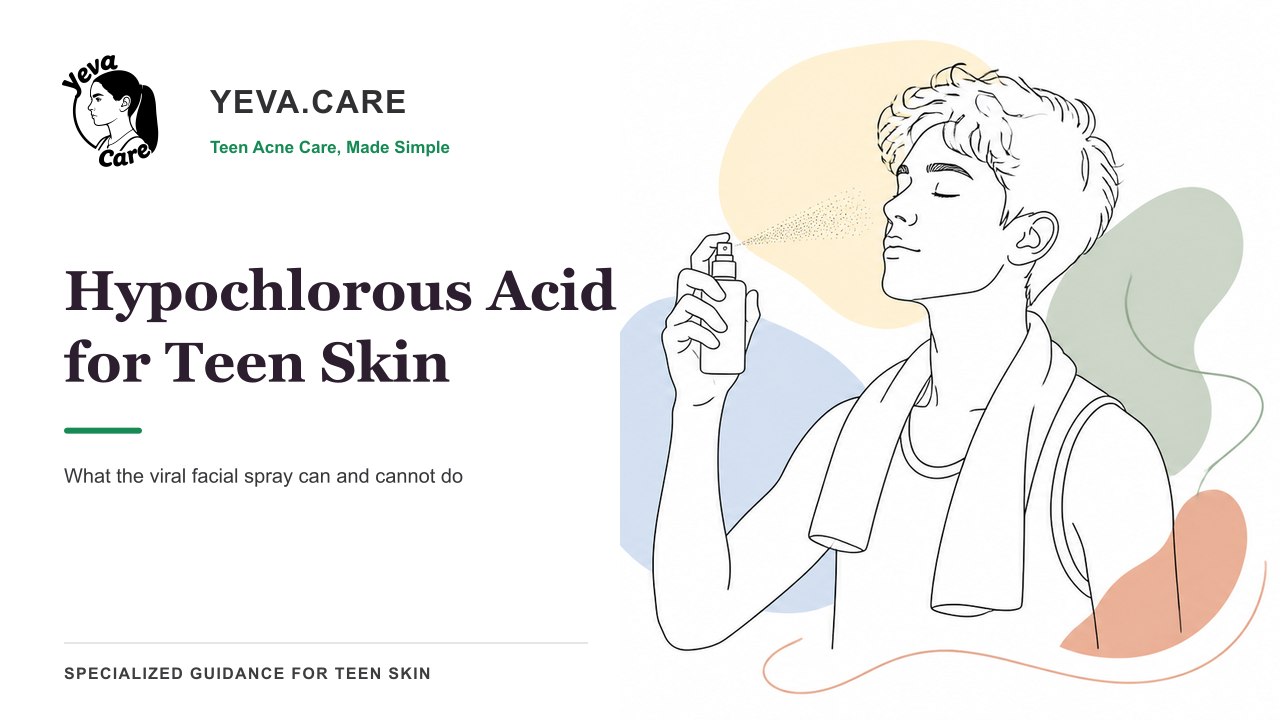
Hypochlorous acid spray has become the product teens keep beside a gym bag, mist after sports, and use between classes. The appeal is obvious: a quick spray feels easier than washing the face, and social posts often describe it as a solution for acne, redness, sweat, and nearly everything else.
The science is more specific. Hypochlorous acid has legitimate uses in skin and wound care, but a facial mist is not automatically an acne treatment. Parents should separate what the ingredient can plausibly do from what a product advertisement promises.
What hypochlorous acid is
Hypochlorous acid, usually shortened to HOCl, is a weak acid involved in the body’s immune response. Certain white blood cells produce it as part of their defense against microorganisms. Manufacturers can also make stable, diluted solutions for topical use.
That biological connection sometimes leads to exaggerated language such as “identical to your immune system” or “kills acne instantly.” A bottled product is still a manufactured formulation with its own concentration, stability, packaging, and intended use. Those details matter.
Laboratory research shows that dilute HOCl can act against several microorganisms. One in-vitro comparison of skin antiseptics included the bacterium historically called Propionibacterium acnes. Laboratory activity, however, does not prove that a consumer mist will clear acne on a teenager’s face.
What the acne research can and cannot tell us
Direct clinical research on the hypochlorous acid facial sprays currently popular with teens is limited. A small randomized trial studied a related dilute chlorine-based solution in mild-to-moderate acne and reported fewer inflammatory lesions. That study evaluated sodium hypochlorite, not every over-the-counter HOCl spray, and it followed a specific protocol.
This distinction is important. Results from one formulation cannot be copied onto products with different chemistry, concentrations, packaging, or directions. HOCl is also sensitive to light, heat, pH, and contamination. A product that has degraded may not behave like the solution originally tested.
The fairest conclusion is that HOCl has a reasonable antiseptic and skin-cleansing rationale, while evidence for treating teen acne remains much thinner than the marketing suggests.
Where a spray may be useful
An appropriately formulated facial spray may be a convenient cleansing support when a teen cannot wash immediately after sweating. That could include the ride home from practice, the time between dance classes, or a long school day under a helmet or chin strap.
It may also feel comfortable on skin that dislikes fragranced wipes or alcohol-heavy mists. Convenience can support better habits, provided the spray does not become an excuse to skip the full evening routine.
What it should not replace:
- a gentle cleanser when sweat, sunscreen, makeup, and surface debris need to be removed;
- a moisturizer when skin feels dry or tight;
- broad-spectrum sunscreen during the day;
- an acne treatment recommended for the teen’s acne type;
- medical assessment for painful, scarring, or persistent breakouts.
For teens whose sports gear seems linked to breakouts, our guide to acne from helmets and athletic equipment covers friction, cleaning habits, and when to seek help.
How to evaluate a product before buying
Choose a product intended for direct use on facial skin, not a household disinfectant, pool chemical, or do-it-yourself mixture. Never make hypochlorous acid at home by combining cleaning products. Household chlorine products can cause serious irritation and dangerous fumes.
Look for a complete label that identifies the manufacturer, ingredients, storage directions, expiration guidance, and a way to contact the company. An opaque bottle may help protect a light-sensitive formula, but packaging alone does not establish quality.
Avoid a mist loaded with fragrance, essential oils, or several extra actives if the goal is to test whether a simple spray agrees with the skin. The more ingredients added, the harder it becomes to understand a reaction. The teen skincare ingredient checker can help families review labels without treating every unfamiliar name as dangerous.
Adding it without turning the routine into a chemistry experiment
Introduce one new product at a time. Follow the product label rather than a social creator’s routine, and do not spray it into the eyes or mouth. Stop if the skin develops persistent burning, swelling, hives, or a spreading rash.
If a teen uses prescription acne medication, has eczema, or is recovering from a procedure, ask the treating clinician before adding a mist. “Gentle” is not a guarantee that every product suits every medical situation.
A simple approach is to keep the spray as an optional post-sweat step and maintain the established morning and evening routine. Avoid repeatedly misting the face simply because the bottle is nearby. More applications do not turn limited evidence into stronger treatment.
Can it be combined with acne ingredients?
Online routines often layer HOCl with salicylic acid, benzoyl peroxide, retinoids, niacinamide, and exfoliating toner in quick succession. The challenge is not always a known chemical conflict. It is the cumulative complexity placed on teen skin.
When several products are started together, irritation becomes difficult to trace. Keep active acne care stable, add only one optional product, and watch how the skin responds over time. If the existing routine already causes dryness or stinging, solve that problem before adding another step. Our guide to repairing a damaged teen skin barrier explains how to simplify when skin becomes reactive.
Signs a spray is not enough
HOCl should not delay care for deep nodules, cysts, rapidly worsening acne, spreading redness, or breakouts that are leaving scars. The same applies when acne is affecting sleep, school, sports participation, or self-esteem.
A dermatologist can determine whether the bumps are acne at all. Folliculitis, contact dermatitis, eczema, and other conditions can resemble a breakout in a phone photo. Repeatedly disinfecting an undiagnosed rash may make the situation harder to interpret.
Hypochlorous acid spray may earn a place in a teen’s bag as a convenient, optional skin-cleansing product. It has not earned the role of universal acne treatment. Buy it for the narrow job it can reasonably perform, keep the core routine simple, and judge results by the skin rather than the trend.